
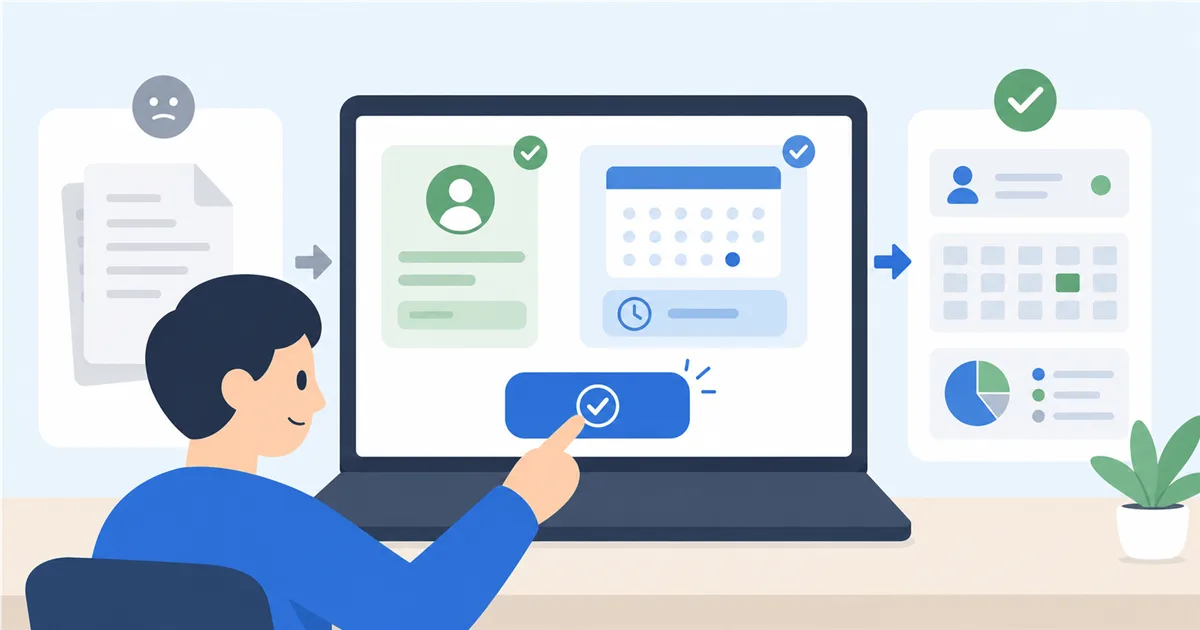
The reason we built the overtime management system was not grand. It was simple: the process was annoying. At Gangbuk Youth Startup Maru, anyone working late had to submit an overtime request through a Google Form, and re-entering the same information every single time turned out to be far more tiring than it sounds.
The Fatigue of Repeated Input
The original process at Gangbuk Youth Startup Maru was straightforward. You filled out a Google Form with your name, company name, office room number, date, and work hours, then submitted it. Once or twice, that is fine. But when overtime becomes frequent, the experience changes completely. You end up typing almost the same information nearly every day, and each submission breaks your focus for a few more minutes. On busy days, the repeated input itself felt more exhausting than the request.
And the problem was not just inconvenience. In a workflow where people manually type the same fields every time, human error comes naturally. Company names can be entered inconsistently. Office room numbers can be mistyped. Dates and time ranges can get mixed up. Writing Room 504 instead of Room 503 is a very realistic mistake. From the user’s point of view, the workflow was tedious. From the administrator’s point of view, it also created messy and inconsistent data.
Save the Common Info, Submit in One Click
So we approached the problem by trying to eliminate the repeated input itself. The idea was to save the common information once, then let users finish the day’s overtime request with a single click after logging in. It was less about creating an entirely new operations system and more about removing the most tiring part of the existing process.
The implementation was short. I built it as a web tool over the course of a day or two. Early on, I used AI tools and Claude Design to sketch the wireframes and screen directions quickly, then connected the front-end flow and the necessary integration pieces for real use. The goal was never to build a huge product from the beginning. The goal was to remove one small but recurring inconvenience as quickly as possible.
What mattered most was not breaking the existing operating model. This system did not replace the Google Form itself. It acted more like a layer that made users stop filling it out the hard way every time. The administrative flow already in place stayed the same, while the user-side input burden was reduced. That also made adoption much easier.
When 5 Minutes Becomes 3 Seconds
The result was clear. If submitting one overtime request used to take around five minutes of attention, now it effectively takes only a few seconds. Because users can complete it with a single tap whenever they remember, there is much less reason to delay it or forget it entirely. Saying that “a daily five-minute task became a three-second action” does not feel like much of an exaggeration.
The response was interesting too. I built it from the user’s perspective, but the side that liked it even more was the administrators. Once repeated manual input disappeared, the chance of typos and missing information dropped, and company names and room details became much more consistent. The team at Gangbuk Youth Startup Maru also responded well to the usability and design, and the tool was even introduced in the group chat used by resident company representatives.
A Small Tool with a Clear Result
Of course, there are limits. This is not a platform that redesigns overtime management as a whole. It does not redefine operating policy or overhaul the full administrative system. It still runs on top of the existing process, and the problem it solves is intentionally narrow and specific. But in real environments, these kinds of improvements tend to last. They are used more often than large, complicated changes because they remove a pain that shows up every day.
What this project confirmed for me is that good tools often begin not with complexity, but with reducing repetition. When the system takes over the things users have to remember, type, and double-check every time, that alone creates real value. That is especially true for internal operations tools and administrative workflows.
I want to keep doing more work in this direction. Big systems that solve big problems matter, but in day-to-day work, it is often the small repeated inconvenience that creates the deepest fatigue. Building something that reduces that friction quickly and makes it usable right away can have a much clearer effect than expected. This overtime management system was a small example of that.